

Key Takeaways
- Healthcare audits evaluate how organizations protect patient information across digital and printed workflows.
- Printers and multifunction devices can introduce security risks if they lack authentication, encryption, and activity monitoring.
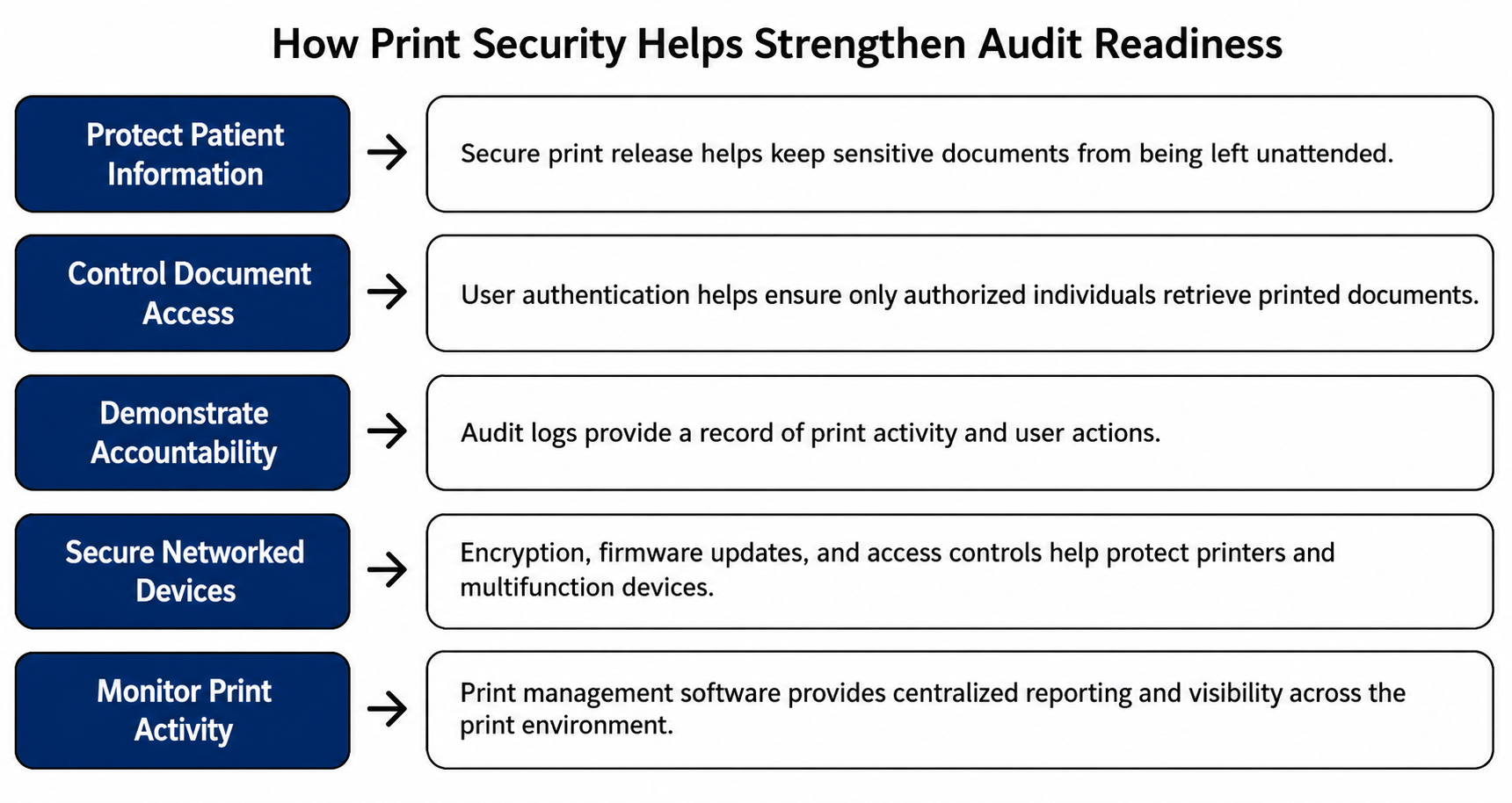
- Features such as secure print release, audit logs, and user authentication help strengthen print security while improving accountability.
- Print management software provides visibility into printing activity, making it easier to monitor usage and support audit preparation.
- A secure print environment is one component of a broader strategy that includes cybersecurity, staff training, and documented security policies.
Print Security Is an Important Part of Protecting Patient Information
From patient intake forms and laboratory requests to prescriptions and discharge instructions, printed documents remain an essential part of healthcare. Even as electronic health records have become the standard, hospitals, medical practices, and specialty clinics continue to rely on printing throughout the patient journey.
Every printed document containing protected health information (PHI) creates another opportunity to either protect or expose sensitive data. A document left on an output tray, an unsecured multifunction printer, or a lack of visibility into printing activity can introduce unnecessary risk.
Healthcare audits increasingly examine how organizations safeguard patient information throughout its lifecycle. While electronic systems often receive the most attention, printers and print workflows are also part of the larger security picture.
Strengthening print security helps healthcare organizations better protect patient information and demonstrate the safeguards auditors expect to see.

What Is Healthcare Audit Readiness?
Healthcare audit readiness refers to an organization’s ability to demonstrate that appropriate safeguards are in place to protect patient information and meet regulatory requirements.
Rather than rushing to gather documentation when an audit is announced, audit-ready organizations maintain consistent policies, security controls, and records throughout the year.
Auditors may review a wide range of areas, including:
- Access to patient information
- Security policies and procedures
- User authentication
- Audit logs
- Device security
- Documentation practices
- Employee training
- Risk assessments
Printed information is part of that process. Healthcare organizations should be able to demonstrate that sensitive documents are protected just as carefully as electronic records.
Why Print Security Matters During Healthcare Audits
Printers are often viewed as office equipment rather than security assets. In reality, today’s multifunction devices store, process, transmit, and sometimes temporarily retain sensitive information.
During a typical day, healthcare staff print:
- Patient charts
- Lab requisitions
- Insurance documents
- Prescription information
- Referral forms
- Consent documents
- Billing records
If those documents are left unattended or accessed by unauthorized individuals, patient privacy may be compromised.
Healthcare audits often evaluate whether organizations have implemented reasonable safeguards to reduce these risks. Print security helps demonstrate that printed information receives the same level of protection as digital information.
Common Print Security Risks in Healthcare
Many healthcare organizations have invested heavily in cybersecurity while overlooking their print environment.
Some of the most common print-related risks include:
Documents Left Unattended
Busy clinical environments make it easy for printed documents to remain on output trays after staff members are interrupted. Those documents may contain sensitive patient information that should only be viewed by authorized personnel.
Shared Devices Without Authentication
If anyone can walk up to a printer and retrieve documents, there is little accountability for who accessed patient information.
Limited Visibility
Without print management software, organizations often have no clear record of who printed a document, when it was printed, or which device was used.
Unsecured Devices
Like computers, printers require regular firmware updates, secure configuration, and appropriate access controls. Older or improperly configured devices may create unnecessary security risks.
Improper Disposal
Printed documents containing PHI should be securely retained or destroyed according to organizational policies. Leaving sensitive documents in recycling bins or unsecured disposal areas increases the risk of unauthorized disclosure.
Secure Print Release Helps Protect Patient Information
One of the most effective ways to strengthen print security is through secure print release.
Instead of printing immediately, documents are held in a secure queue until the authorized user authenticates at the device using a badge, PIN, password, or another approved method.
This simple change offers several important benefits.
Sensitive documents remain protected until the intended user is present to collect them. The risk of abandoned print jobs is significantly reduced, and organizations waste less paper by eliminating forgotten or duplicate print jobs.
Secure print release also supports greater accountability because the organization can verify when documents were released and by whom.
For healthcare environments where patient privacy is essential, secure print release provides an additional layer of protection without creating unnecessary complexity for staff.

Audit Logs Create Greater Accountability
Healthcare audits often focus on evidence rather than assumptions.
It is one thing to have a written security policy. It is another to demonstrate that security controls are consistently being followed.
Modern print management solutions can generate audit logs showing:
- Who submitted a print job
- When it was printed
- Which device was used
- Whether authentication occurred before release
- Printing trends across departments
- Unusual printing activity
These reports provide administrators with greater visibility into their print environment while supporting internal investigations, policy reviews, and compliance efforts.
Instead of relying on manual recordkeeping, organizations have objective data that helps demonstrate stronger information governance.
Printer Security Goes Beyond Printed Documents
Many organizations forget that multifunction printers are network-connected computers.
They store data, communicate with other systems, and process confidential information throughout the day.
Protecting these devices may include:
- Data encryption
- Secure boot technology
- Firmware updates
- Hard drive overwrite or data sanitization
- Network segmentation
- Administrative access controls
- Disabling unused ports and protocols
These safeguards help reduce the likelihood that printers become an overlooked vulnerability in the healthcare environment.
Print Visibility Supports Better Decision-Making
Preparing for an audit is much easier when organizations understand what is happening across their print environment.
Print management software can provide valuable reporting, including:
- Print volume by department
- Device utilization
- Colour versus black-and-white printing
- User activity
- Supply consumption
- Security policy compliance
This visibility helps administrators identify trends, enforce print policies, and address potential issues before they become larger problems.
For example, reports may reveal that sensitive documents are consistently being printed to shared devices in public areas or that certain departments require additional security controls.
These insights support continuous improvement rather than reactive problem-solving.

Print Security Is Part of a Larger Security Strategy
While print security plays an important role in protecting patient information, it should never be viewed as a standalone solution.
Healthcare organizations strengthen audit readiness by combining secure printing with other best practices, including:
- Identity and access management
- Endpoint protection
- Employee security awareness training
- Regular risk assessments
- Document retention policies
- Data backup and recovery
- Ongoing cybersecurity monitoring
Together, these measures create a more comprehensive approach to protecting sensitive information while supporting compliance with healthcare regulations.
As healthcare organizations continue to modernize their technology, print security remains an important piece of the overall security strategy rather than an afterthought.
Protect Patient Information with a More Secure Print Environment
Healthcare organizations depend on secure access to information every day. Strengthening print security can help reduce unnecessary risk, improve visibility into document handling, and support broader healthcare audit readiness efforts.
Whether you’re evaluating your current print environment or planning for future technology improvements, Modern Office Methods can help you implement print solutions that support both patient care and information security.
Frequently Asked Questions
Do healthcare audits only apply to hospitals?
No. Healthcare audits may apply to hospitals, physician practices, dental offices, outpatient clinics, imaging centres, long-term care facilities, and other organizations that handle protected health information, depending on the applicable regulations and programs.
Can older printers be secured, or do they always need to be replaced?
Many existing printers can be made more secure through firmware updates, secure configuration, authentication features, and print management software. However, older devices that no longer receive security updates or lack modern security capabilities may warrant replacement.
How often should healthcare organizations review their print security policies?
Print security should be reviewed as part of an organization’s broader security and risk management program. Many healthcare organizations evaluate security policies annually or whenever significant changes are made to their technology environment, workflows, or regulatory requirements.
About Modern Office Methods (MOM)
Modern Office Methods has helped businesses navigate their document challenges for over 60 years. They offer Production Print Solutions, Managed Print Services, Software Solutions and IT Services to help enhance their customers’ business processes while reducing expenses.
For the latest industry trends and technology insights, visit MOM’s main Blog page.
Leave A Comment
You must be logged in to post a comment.